

News/All pieces
MoorMic/KoosMic

Peatland sound live & recorded
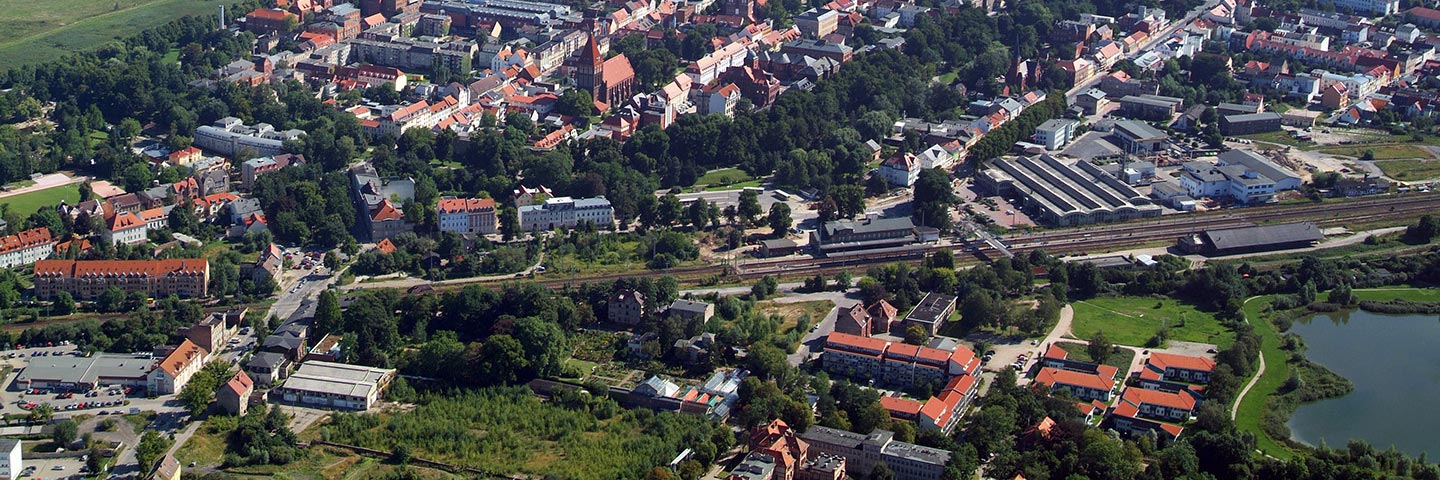
2/09/2025 MoorMic/KoosMic – the microphone for the sound of the landscape directly from the coastal peatland – for everyone to listen to! KoosMic, because this new listening station is located on the island of Koos just outside Greifswald. From there, it transmits live and in recorded soundscapes of the surrounding habitats, the sounds of peatland meadows, pastures, and hedges. Wind in the reeds, rain on the shore, cows snorting, cranes calling – depending on the weather and season.
The MoorMic/KoosMic is part of the global acoustic cartography radio.aporee by media artist Udo Noll. He worked on it together with students of “Acoustic Ecologies and Sound Studies” at the Bauhaus University Weimar and their professor Kerstin Ergenzinger. Unobtrusive, virtually maintenance-free, solar-powered, and installed with minimal impact on the landscape – the group has successfully implemented its criteria for the MoorMic/KoosMic. The MoorMic has been transmitting since early summer. It has only had to be moved once so far. Cows had been sniffing at it too wildly.
The listening station is intended to promote awareness and perception of the environment. In line with the interdisciplinary research of “acoustic ecology,” it enables the condition and changes in landscapes to be recorded via sound. It is also about sharing and documenting the sound of the world. Almost everyone captures their world in pictures and videos, but what about sound snippets?
The island sound of the marshy coast of Greifswald Bay is available thanks to MoorMic/KoosMic – from anywhere, anytime, and for everyone. For a listening session, simply tune in at radio.aporee.org:8443/koosmic.
Agriculture on Europe's peatlands?
New map shows where
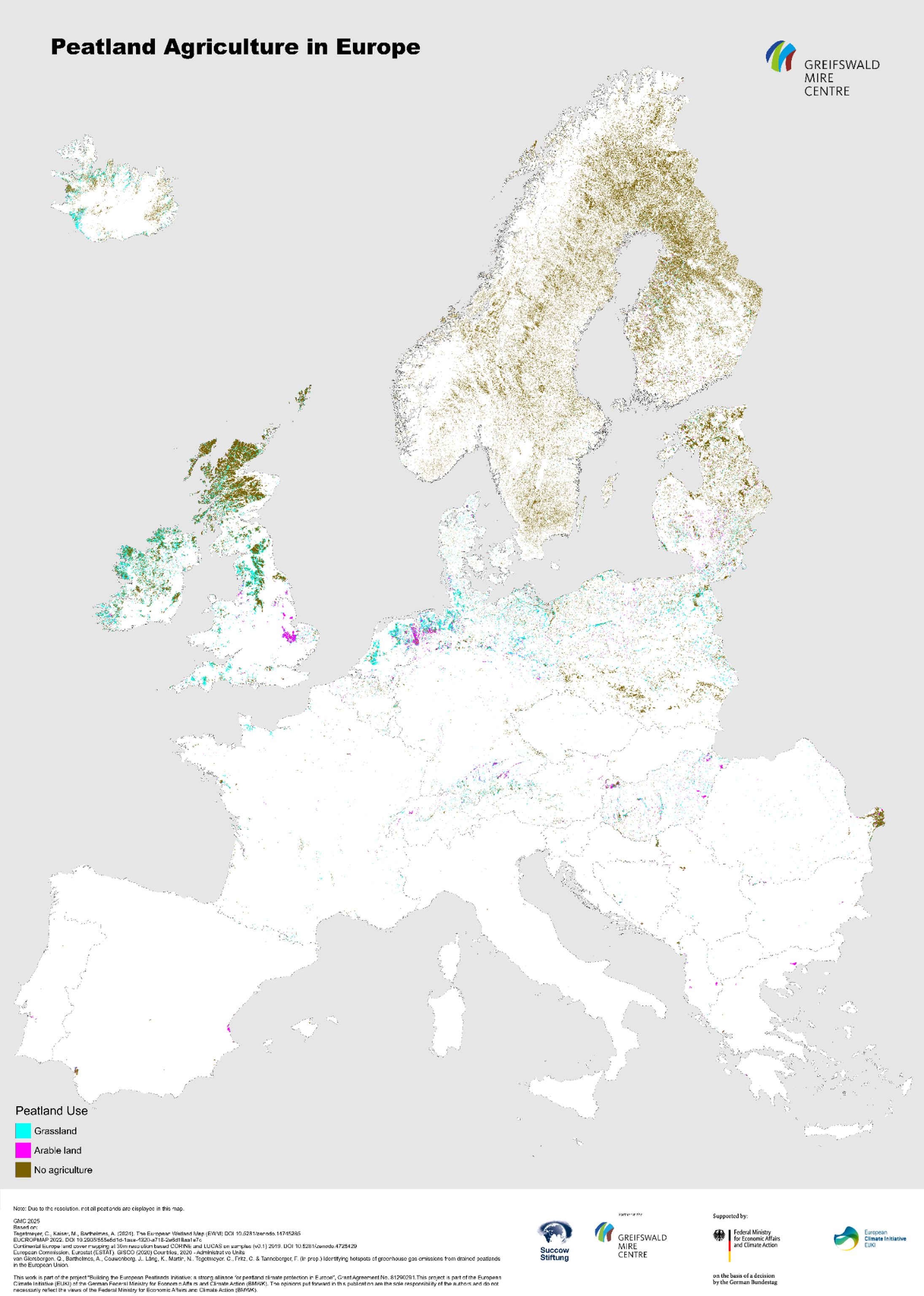
1/09/2025 Across Europe many wetlands are drained for agriculture, releasing vast amounts of CO₂ into the atmosphere. Identifying where these drainage “hot spots” occur—whether for arable crops or grassland—is critical to promoting wet alternatives such as paludiculture.
As part of the project Building the European Peatlands Initiative: A Strong Alliance for Peatland Climate Protection in Europe, researchers have combined the latest European Wetland Map with land cover data to produce a new map showing the agricultural use of peatlands in the European Union and several neighboring countries (Verlinkung von GMC). This map offers valuable insights for policymakers, conservationists, and the interested public seeking sustainable solutions. The map is based on data from the Global Peatland Database (GPD), which collates and integrates data on location, extent and drainage status of peatlands and organic soils worldwide and for 268 individual countries and regions.
The project is part of the European Climate Initiative (EUKI), funded by the German Federal Ministry for Economic Affairs and Climate Action (BMWK) and implemented by the Deutsche Gesellschaft für Internationale Zusammenarbeit (GIZ) GmbH. Project partners include Eurosite, CEEweb and the European Landowners’ Organization (ELO).
Pioniering for more practice

in planting reed
27/08/2025 80,000 young plants have been planted in the Bargischow-Süd polder in Vorpommern since mid-July. An impressive action! As part of the Paludi-MV project, a dense, high-quality reed bed is to be created here for agricultural use. A tractor with a strip tiller has drawn long rows in the grass on the previous grassland before a soil auger prepared the planting holes, and the seedlings were transported and planted in the field using a quad. After planting, the area will be flooded. The harvest is planned for winter when the plants have lost their leaves and no birds are nesting. In the past, fodder for livestock was grown here, but due to high water levels and soil degradation, the quality was inadequate. Long-term drainage has decomposed the peat, and the polder has settled by over a meter in height. Today, it is therefore one meter below sea level. This is where the reeds come into play as an alternative! They can be used for thatched roof, plaster carriers, insulation boards or cellulose for papers and cartons. Since experience in reed cultivation is still rare, PaludiMV is examining the costs and challenges of planning and implementation.
The pilot project "Paludi-MV" is jointly implemented by the Landgesellschaft Mecklenburg-Vorpommern mbH und der Universität Greifswald , and it is funded by the Federal Ministry for the Environment . The goal is to test paludiculture on two polder areas: Bargischow-Süd (LK Vorpommern-Greifswald) and Sandhagen (LK Mecklenburg Lake District).
Capturing the value of wetlands – digitally

The Paludiculture Interview
25/08/2025 What is the value of peatlands? How can the ecosystem values of rewetted areas in particular be captured and quantified? With the Moormonitor, product designer and peatland enthusiast Milan Bergheim and his colleagues in the Valpeats project are developing an economical and practical monitoring system for this purpose. The aim is to enable peatland areas to be rewetted more quickly and over a larger area and used for paludiculture. Read the full interview here.
Moorkoffer, the Second

Even Moore Fun and a Song Collection
28/07/2025 The Moorkoffer 2 (in german) is not a finished suitcase – it is a collection of educational materials for peatland and climate education, designed for teachers, environmental educators, volunteers, and anyone actively engaged in education for sustainable development.
The publication contains 50 methods: from soil drilling and role-playing games to experiments, meditations, and creative reflection formats. These methods are flexible, location-based, and adaptable to different needs – they can be used even without access to a real peatland. All materials are freely available and can be used and shared under the CC BY-NC license, meaning non-commercial use with attribution.
Additionally, there's the musical audio play "Im Libellenwunderland" (in german) for children in daycare centers and primary schools, which playfully explores topics such as biodiversity, water scarcity, and climate change. It is available on Spotify, YouTube, and SoundCloud. The booklet “IM.MOOR.SEIN.”, designed to promote mindful sensory experiences in peatlands, guides individuals and groups of all ages through all four seasons. All materials were developed as part of the MoKKa project by the Succow Foundation and the University of Greifswald.
RRR2025 - Programme & Highlights

Check it out now!
24/07/2025 From hands-on workshops to eye-opening excursions, the 4th International Conference on Renewable Resources from Wet and Rewetted Peatlands (RRR2025) promises a rich and diverse experience. Researchers, practitioners, and policymakers from around the world will come together to discover paludiculture from all perspectives: in 2 key notes, 82 oral and 66 poster presentations.
Programme highlights include:
- Workshops – In-depth sessions for collaboration, training, and knowledge exchange
- Excursions – Visits to innovative peatland sites with Eddy towers, solar panels, and more
- Paludiculture Exhibition – Latest products made from wetland biomass
- Paludishow and conference dinner – A joyful and interactive evening of learning and entertainment great for networking
- Creative side events – Including a zombie fire documentary and immersive peatland soundscapes
Register by 15 August 2025 to secure your place in this unique international gathering.
Details and registration: rrr2025.com
Questions? Contact us at: info@rrr2025.com
Please feel free to share this information with colleagues or partners who might be interested.
Paludi Product Catalogue, ProMoFa and more

New issue of the Paludiculture Newsletter
20/07/2025 The new issue of the Paludiculture Newsletter is here – packed with highlights and background information on peatland conservation and paludiculture!
Some topics in the current issue:
- Programme highlights of RRR2025 – more information about the international conference
- The big collecting: the Paludi Product Catalog aims to showcase current products in one place
- Peatlands & Defense – an unusual perspective
- Regional insights: Peatland conservation how-tos – handouts for Lower Saxony and Schleswig-Holstein
- ProMoFa project in Bavaria – results and practical insights
- Valpeats & Peatland monitor – an interview on the digital assessment of peatland areas
Also: new publications, and an overview of current events on peatlands, climate protection, and paludiculture in the calendar. We hope you enjoy reading and welcome feedback on the newsletter by email to communication@greifswaldmoor.de.
Paludi Product Catalogue

Be part of it!
11/07/2025 The catalogue aims to provide an overview of products, prototypes, and services related to the use of wet or rewetted peatlands. The focus is on highlighting the diversity and innovative strength of the companies involved. The Paludi Product Catalogue is a joint initiative by the partners of the PaludiNetz network but is also open to contributions from outside the network.
To reach the widest possible international audience, the catalogue will be published in both German and English. It will be distributed free of charge in printed form and may also be made available online (depending on the platform). Participation is voluntary and free of charge. The participating companies are responsible for the content they submit. The first edition of the catalogue at the RRR Conference in Greifswald this September.
A prerequisite for inclusion is that submissions are clearly related to the utilisation of wet or rewetted peatlands. The catalogue does not cover management practices or biomass processing technologies. For this area, the project PaludiZentrale is planning a separate platform coming up soon: PaludiScout.de.
If you would like to place a product in the catalogue, you may find the submission form in German or in English or contact the catalogue’s team via email to produktkatalog@greifswaldmoor.de. The team can also help with translations.
Environmental minister Schneider at GMC

at inaugural visit to MV
04/07/2025 On 3 July 2025, Federal Minister Carsten Schneider of the German Federal Ministry for the Environment, Climate Protection, Nature Conservation and Nuclear Safety (BMUKN) had a stopover at the Greifswald Mire Centre during his first official inaugural trip through Mecklenburg-Western Pomerania. The message was clear: peatlands must remain at the top of the agenda in today's environmental policy.
Franziska Tanneberger, winner of the German Environmental Award 2024, and colleagues demonstrated at various places in and around Greifswald how science on peatlands can be used as a basis for political decisions, how business models can be developed from sustainable peatland use and how these can be scaled up. At the Karrendorfer Wiesen, Schneider could observe field research of the DFG-funded WETSCAPES project of the University of Greifswald on the ground and also the peatland protection of the Succow Foundation, which owns the nature conservation areas there.
At Greifswald itself, the GMC peatland experts took the VIP-visitor to the mesocosm facility, which monitors plant growth in 108 mini peatlands, to a clone collection of 200 reed and 500 peat moss clones, as well as to the peatland library with more than 50,000 publications. They showed the database on peatlands worldwide and at the Michael Succow Foundation first paludiculture products from an an alliance of several companies. This all made clear:
The Greifswald Mire Centre‘s work has not only raised public awareness over the last 10 years, but has also attracted the interest of large business groups. Germany thus has the opportunity to expand its pioneering role in climate protection through rewetting and paludiculture. Environmental Minister Schneider was impressed: "The University of Greifswald’s peatland research is a unique selling point! MV Environment and Agriculture Minister Dr Till Backhaus also supports the long-term preservation and expansion of this in a non-university research institution.
New: Guidelines for Peatland Protection
This is how it's done in Lower Saxony and Schleswig-Holstein!
03/07/2025 To ensure that rewetting and restoration efforts don’t get bogged down in lengthy planning, approval, or implementation phases, two brand-new guidelines have just been published for Lower Saxony and Schleswig-Holstein—with contributions from the Greifswald Mire Centre.
 |
 |
Published by the German Federal Agency for Nature Conservation (BfN), the Guidance for Planning, Financing and Approval provides an overview of the key steps involved in the planning, funding, and approval of peatland protection projects and associated measures. With over 545,000 hectares of carbon-rich peat soils, Lower Saxony has the highest peatland area of any German federal state. However, the majority has been drained for agriculture, forestry, or peat extraction. Clearly, there’s a lot to be done. Particularly helpful are the included tips on how to accelerate and simplify projects, along with an overview of funding programs and key contacts in the region.
If land is available, data on the site exists, nature conservation requirements must be considered, or questions arise - such as potential pollution from World War II - these and more are addressed by the equivalent guideline for Germany’s northernmost state: the Guidance for Planning and Approval of Peatland Protection Projects in Schleswig-Holstein, published in the series of the Greifswald Mire Centre. Covering 129,800 hectares, Schleswig-Holstein's peatlands have mostly been drained - causing negative impacts on biodiversity, climate, and the water cycle.
Both publications are aimed at public authorities, municipalities, foundations, associations, agricultural enterprises, and private individuals.
The guidance for Lower Saxony was developed in a collaboration between the MoorNet and MoKKa projects by the Michael Succow Foundation and DUENE e.V. (both partners of the Greifswald Mire Centre), the Ecologic Institute, and the Lower Saxony State Agency for Water Management, Coastal and Nature Conservation (NLWKN). The Schleswig-Holstein guideline was created as part of the MoKKa project by GMC partners Succow Foundation and the University of Greifswald, in cooperation with the Ministry for Energy Transition, Climate Protection, Environment and Nature of Schleswig-Holstein (MEKUN).